|
|
Across the Nile from Luxor, on the West Bank, sits the necropolis of Ancient Thebes, an enormous land of tombs and temples built to honor the Pharaohs, Queens, princes and princesses, and other nobles and priests who are entombed there in quest for everlasting life.
As you approach the heart of the West Bank, the first monuments you see are the Colossi of Memnon, a twin pair of statutes that are all that remain of an ancient temple. Close to 40 feet tall, they are rather impressive with the backdrop of the mountains that are home to the tombs of so many Kings and Queens of Ancient Egypt.
Throughout the barren mountainside sit small valleys which are home to countless tombs ranging from the ordinary to the most extraordinary. From the tomb of Tutankhamon, for instance, the amazing treasures that are now housed in the Egyptian Museum in Cairo were discovered. While some of such tombs are open to the public, most are not and excavation and archaeological work continues.
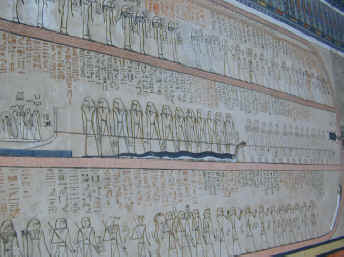
The tombs are amazing--often long corridors descending into rooms, chambers and, ultimately, the burial chamber. The walls were often intricately decorated and painted as here--much of the art is remarkably well-preserved, and the colors still bright, given the dry, low-humidity, climate which is perfect for preservation.
In the spectacular tomb of Amenophis II, his carved stone coffin still sits. Given the strong belief in the afterlife, Pharaohs such as Amenophis would be mummified in an elaborate procedure, and buried in ornate tombs filled with treasures and ordinary objects alike--all to be of use in the afterlife. Unfortunately, all of such tombs were robbed of their most splendorous items but for the tomb of King Tut, first discovered in 1922.
The tomb of Amenophis II is one of the best preserved in the Valley of the Kings. Displayed below are spectacularly vivid wall paintings which look as though they were executed only recently.
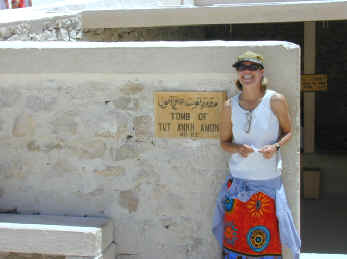
Outside the tomb of King Tut--while the smallest of the tombs found in the Valley of the Kings, it was the only one discovered to date that had not previously been plundered, giving rise to its significance and fascination.
Sadly, it was also here, in 1997, where 58 tourists were massacred by machine gun wielding terrorists.
The Temple of Hatshepsut was a mortuary temple where embalming and other funerary sacraments and procedures would take place in preparation of the deceased for the afterlife.
Our next destination is the beautiful Nubian city of Aswan, Egypt. |
|
2 Go Maps / 2 Go Actual Itinerary / 2 Go Photos / 2 Go Home Page
PLEASE E-MAIL US. . . WE WOULD LOVE 2 HEAR FROM YOU!
©1999-2001 Kelly and Rich Willis. All rights reserved. |


 The Temple of Hatshepsut,
the female pharaoh, is an amazing piece of architecture which rises from the
desert and merges with the sheer limestone cliffs that rise behind it.
Queen Hatshepsut reigned between 1490-1470 B.C. and was known for her great
building activities and her peaceful expedition to Punt (Somolia) where she
brought back fine fine incense trees, giraffes and other exotic
items.
The Temple of Hatshepsut,
the female pharaoh, is an amazing piece of architecture which rises from the
desert and merges with the sheer limestone cliffs that rise behind it.
Queen Hatshepsut reigned between 1490-1470 B.C. and was known for her great
building activities and her peaceful expedition to Punt (Somolia) where she
brought back fine fine incense trees, giraffes and other exotic
items.