

|
|
We thought it only fitting to begin our African experience with an animal safari (fyi: safari is Swahili for journey). Our safari in the Masai Mara was by no means an ordinary journey. When we left Atlanta roughly 14 months ago, we were given the extraordinarily generous gift of three days accommodation anywhere in the world. We had been saving it for a special place and the Olonana luxury safari camp was absolutely perfect. We left Nairobi on October 29th, which just so happened to be our 6 year anniversary. We were flown to the Masai Mara on a small Air Kenya two prop plane. Even before we landed, we could see zebras, giraffe and wildebeests running across the open plains.
We caught the end of the great wildebeest migration where millions of wildebeests make their way south from the Masai Mara in Kenya down to the Serengeti in Tanzania. Both parks are part of one large wildlife reserve.
Our first impression of the Masai Mara was that we were in the Garden of Eden. Animals roamed freely and happily through the beautiful plains eating from the grass and the trees with scenic mountains in the background.
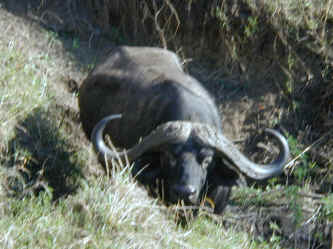
Within our first 24 hours in the Masai Mara we spotted the "Big 5" animals of Africa (Buffalo, Lion, Rhino, Elephant and Leopard). Our first Big 5 creature was the Buffalo (Swahili name: Nyati). This is a male buffalo as his horns are much larger and heavier than those of a female. He could really mess you up with those horns. The male buffalo can weigh up to 800 kilograms and lives an average of 20 years.
The Lion (Simba) has not been dubbed the King of the Jungle for nothing. The lion is a beautiful and confident animal that is feared by all. This is a male simba as he has the big hairdo. The male lion can weigh up to 500 pounds. This lion is sitting in the shade and wiping his face after feasting on a zebra (see later: The Circle of Life). Incidentally, lions spend 16 to 20 hours of their day resting in shady areas.
Hunted for his infamous horn, the Rhino is an endangered animal. We were fortunate to see this black rhino during our first game drive. While he is strong enough to conquer most animals, the peaceful rhino is content with grass. He must eat a lot of it, because he is a chubby thing.
The Leopard (Chui) is quite an elusive animal, and is usually the member of the Big 5 that folks miss out on. Found in both Africa and Asia, the Leopard is distinguished from other spotted cats by her large size and her beautiful black necklace of spots which she sports around her neck and the bars across her chest. Leopards are exceptional tree climbers and they will hunt by day or night. Here we have a female leopard with her smaller daughter on the left.
At this point we find it only appropriate to introduce you to the man who is responsible for all of these wonderful sightings: Lima. Lima was our game driver and guide. He was a lovely gentleman who wanted to make sure that our first safari in Africa was a great one. We highly recommend him if you visit the Masai Mara.
|
|
2 Go Maps / 2 Go Actual Itinerary / 2 Go Photos / 2 Go Home Page
PLEASE E-MAIL US. . . WE WOULD LOVE 2 HEAR FROM YOU!
©1999-2001 Kelly and Rich Willis. All rights reserved. |




 Speaking of
chubby, the African Elephant (Tembo) can weigh up to 6 tons. Also a
vegetarian, he eats up to 300 kilograms of vegitation and drinks up to 200 liters
of water in one
day. In fact, the tembo will usually spend 16 hours of his day eating (the
remaining 8 hours are divided by 4 hours of wallowing in mud and 4 hours
sleeping standing up). The elephant finds trees to be quite delicious, and
you can tell if an elephant has been around by the trail of destroyed trees and
the heaps of dung. Elephants are highly social and will sometimes
join up in groups of 40 or 50 to search for water. We counted 42 elephants
in this group, pushing on purposefully across the savannah . It was quite an impressive site.
Speaking of
chubby, the African Elephant (Tembo) can weigh up to 6 tons. Also a
vegetarian, he eats up to 300 kilograms of vegitation and drinks up to 200 liters
of water in one
day. In fact, the tembo will usually spend 16 hours of his day eating (the
remaining 8 hours are divided by 4 hours of wallowing in mud and 4 hours
sleeping standing up). The elephant finds trees to be quite delicious, and
you can tell if an elephant has been around by the trail of destroyed trees and
the heaps of dung. Elephants are highly social and will sometimes
join up in groups of 40 or 50 to search for water. We counted 42 elephants
in this group, pushing on purposefully across the savannah . It was quite an impressive site.

 While the
hippopotamus is not a member of the Big 5, we think that he ought to be.
The Hippo (Kiboko) is a beautiful and fascinating animal. The
Olonana camp sat on a river that was home to many hippos, so we were able to get up
close and personal with these chubby creatures which, incidentally, can weigh up
to 3200 kilograms. The hippo is a social animal by day as he wallows in
the river with his buddies. However, by night, he is a solitary grazer who
marches up on land and chows down on enough grass to get by until the following
evening. We did, however, see many hungry hippos eating during the day as
well.
While the
hippopotamus is not a member of the Big 5, we think that he ought to be.
The Hippo (Kiboko) is a beautiful and fascinating animal. The
Olonana camp sat on a river that was home to many hippos, so we were able to get up
close and personal with these chubby creatures which, incidentally, can weigh up
to 3200 kilograms. The hippo is a social animal by day as he wallows in
the river with his buddies. However, by night, he is a solitary grazer who
marches up on land and chows down on enough grass to get by until the following
evening. We did, however, see many hungry hippos eating during the day as
well.